
Views: 0 Author: Site Editor Publish Time: 2025-08-14 Origin: Site


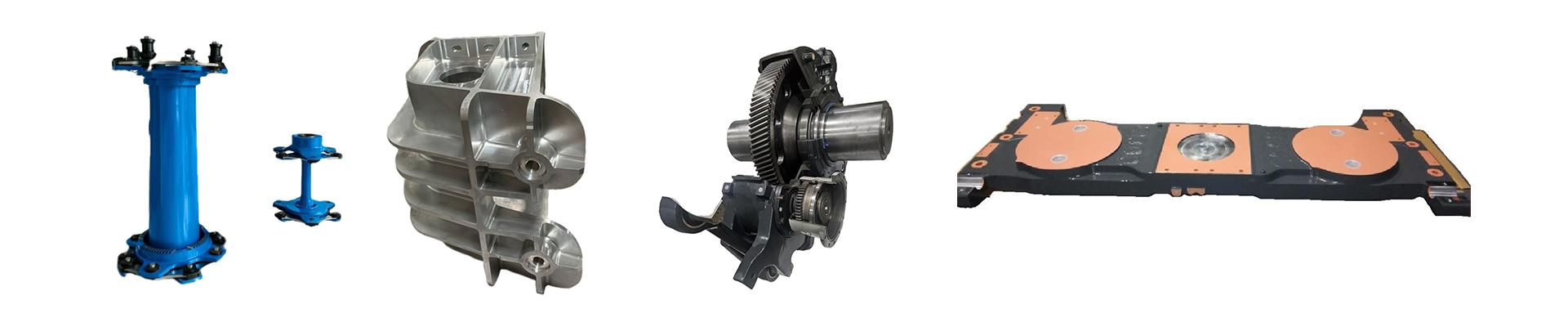
What are some characteristics and challenges of the rail transit industry?
Characteristics:
Rail transit systems have extremely high safety requirements. All core components must withstand long-term high-frequency operation and sustained high-intensity loads, maintaining structural stability without deformation or fracture under extreme conditions, meeting international safety standards. Safety control is implemented throughout every stage, from material selection and manufacturing to final inspection.
Many parts, such as chassis connections, bogie supports, and brake system components, feature complex structures and uneven wall thicknesses, placing very high demands on machining equipment and process capabilities.
Dimensional accuracy, tolerance control, and fit clearance requirements are extremely stringent. Consistency and interchangeability of each batch must be ensured, imposing rigorous demands on machining processes and quality management systems.
Challenges:
When machining high-strength steel and wear-resistant materials, rapid tool wear and high cutting heat generation are common issues. It is necessary to precisely control cutting parameters and use high-performance cutting tools.
Large parts often contain residual stresses after welding or heat treatment. Methods such as stress-relief aging, precise fixturing, and path optimization must be applied to reduce the risk of deformation.
Parts often feature internal cavities, deep holes, or irregular contours, posing challenges for multi-axis machining and long overhang tool control. Requirements for surface roughness, stress distribution, and surface strengthening are stringent and must consider material properties and subsequent processes comprehensively.
Products must comply with international standards such as EN, DIN, and ISO. A complete system of quality documentation, machining records, and measurement reports must be established to ensure full process traceability and successful third-party audits.
Core Equipment and Process Flow for Manufacturing Rail Transit Components
Core Equipment:
Five-face Gantry Machining Centers, Horizontal Machining Centers, Vertical Machining Centers, CNC Lathes, Precision Grinding Machines, and Coordinate Boring and Milling Machines.
Process Flow:
Raw Material Cutting, Rough Machining, CNC Precision Machining, Grinding and Drilling Processes, Finishing and Inspection, Pre-assembly Testing, and Packaging for Shipment.
Technical Advantages of Equipment
Equipped with imported high-precision five-axis machining centers, coordinate grinding machines, and CMM inspection equipment, achieving machining dimensional accuracy of ±2~5μm. This meets the stringent requirements for high-precision fitting parts and is widely used in critical load-bearing components and high-end assembly structures.
The equipment features high dynamic rigidity and heavy-duty construction, suitable for efficient and stable machining of medium to large welded assemblies, ribbed structures, and other deformation-prone parts. Intelligent clamping fixture systems combined with high-torque spindles effectively reduce deformation and vibration during machining, improving overall yield.
All equipment is equipped with branded high-end CNC systems, integrated with self-developed process databases and parameter optimization systems to achieve intelligent tool path planning and process monitoring, ensuring machining consistency and reducing setup time.
What components can we manufacture for the rail transit industry?
Wheels, Axles, Axle Boxes, Nuts, Washers, Bearing Housings, Connecting Pins, Link Brackets, Gears, Gear Rings, Drive Shafts, Transmission Shafts, Couplings, Flanges, Traction Rods, Conduit Connectors, Cast Sleeper Beams.
