


| Quantity: | |
|---|---|


The fluid end is engineered to withstand ultra-high pressure environments commonly required in hydraulic fracturing operations. Designed for continuous high-load pumping, it ensures stable pressure output and efficient fluid transmission into the wellbore. The robust structure minimizes deformation under cyclic stress, improving operational safety and reducing downtime. It is suitable for demanding oilfield applications where consistent high-pressure performance is critical for production efficiency and reservoir stimulation.
Manufactured from premium alloy steel materials such as 4330V and 4145H, the fluid end undergoes advanced forging and heat treatment processes to achieve superior mechanical properties. This ensures excellent toughness, fatigue resistance, and structural integrity under extreme working conditions. The forged body significantly extends service life compared to conventional cast components, making it highly reliable for long-term oil and gas operations.
All critical sealing and flow passages are produced using CNC precision machining to ensure high dimensional accuracy and consistent performance. Tight tolerance control reduces leakage risks and improves volumetric efficiency during high-pressure pumping cycles. This level of precision also enhances compatibility with major fracturing pump systems used in global oilfield operations.
The fluid end is designed with enhanced wear-resistant surfaces to handle abrasive fracturing fluids containing sand and proppants. Optimized internal flow geometry reduces erosion and turbulence, significantly extending service life. Compared with standard designs, maintenance intervals are reduced, helping operators lower overall operational costs and improve equipment uptime in harsh field conditions.
| Product Parameters | Content |
| Product Name | Frac Pump Fluid End Series |
| Application | Hydraulic Fracturing Equipment |
| Material | 4330V, 4145H Alloy Steel or Equivalent |
| Manufacturing Process | Forging, Heat Treatment, CNC Machining |
| Structure Type | Integrated Forged Fluid End |
| Available Configurations | 3+2 Fluid End, Quintuplex Fluid End |
| Machining Accuracy | Precision CNC Machining |
| Inspection Standard | UT, MT, Dimensional Inspection |
| Certification | ISO 9001 Compliant Manufacturing |
| Industry Application | Oil & Gas, Hydraulic Fracturing, Well Stimulation |
| Working Pressure | Up to 137.9 MPa |
| Available Configurations | Triplex, 3+2, Quintuplex Fluid End |
| Stroke Length | 203.2 mm (8") |
| Plunger Diameter Range | 88.9–127 mm |
| Flow Rate Range | Up to 4247 L/min |
| Product Type | Fracturing Pump Fluid End |
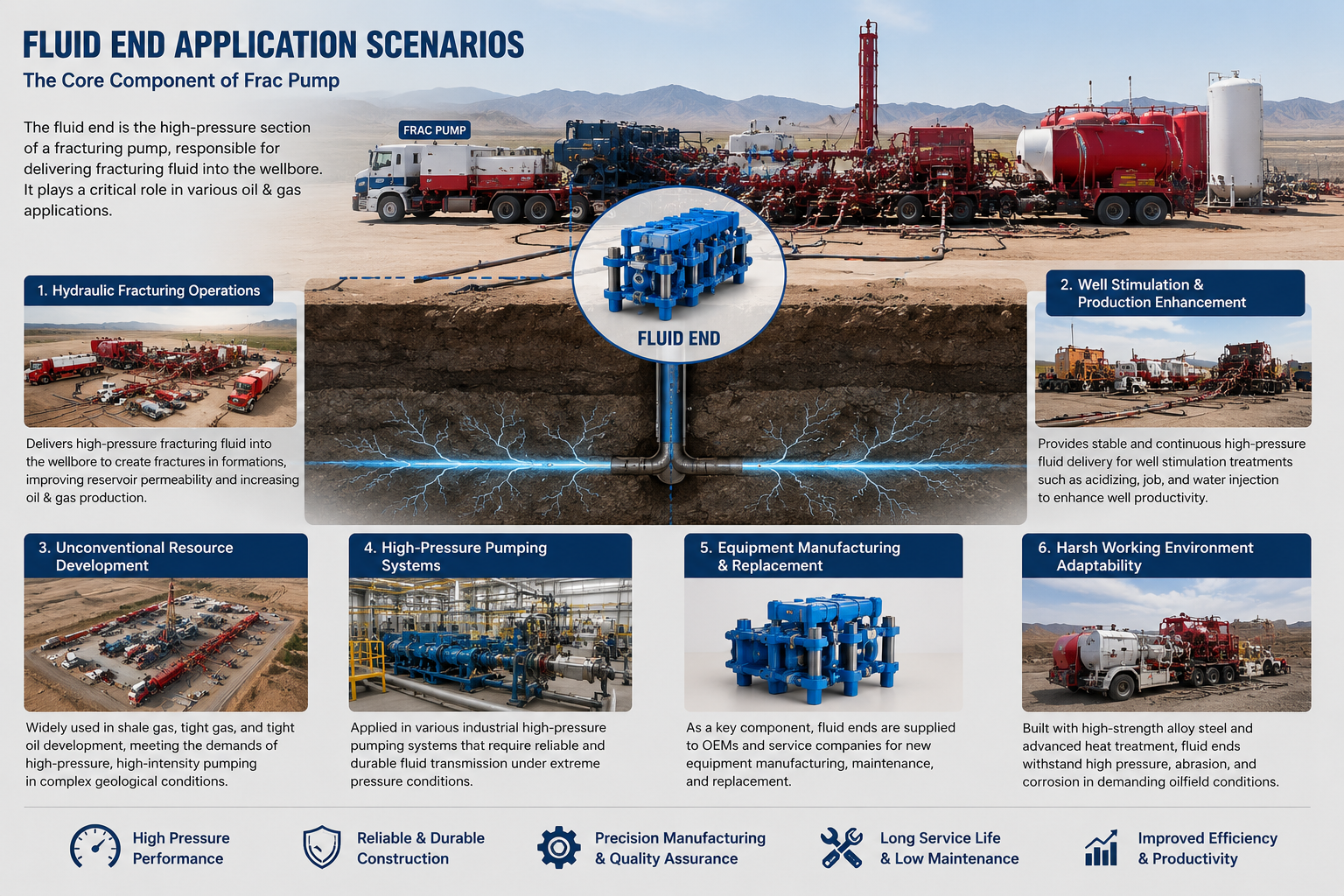
The fluid end is widely used in hydraulic fracturing equipment for oil and gas exploration and production. It delivers high-pressure fracturing fluids into the wellbore to create fractures in underground formations, improving reservoir permeability and increasing hydrocarbon recovery rates. Its high-pressure capability and durability make it an essential component in modern shale oil and gas development projects.
During well stimulation operations, the fluid end provides reliable high-pressure fluid delivery to improve the productivity of existing wells. It helps operators maximize output from mature or low-permeability reservoirs while maintaining stable pumping performance under demanding field conditions.
The fluid end is extensively applied in unconventional resource extraction projects, including shale gas, tight gas, and tight oil development. Its robust structure and wear-resistant design enable continuous operation in harsh environments where high-pressure pumping systems are required for efficient resource recovery.
Beyond fracturing applications, fluid ends can be integrated into various industrial high-pressure pumping systems that require reliable fluid transmission under extreme pressure conditions. Their forged construction and precision machining ensure long service life and dependable performance in critical operations.
Fluid ends are commonly supplied to oilfield equipment manufacturers and service companies as key components for new equipment production, maintenance, and replacement projects. They are designed to meet the demanding requirements of oilfield operations and support long-term equipment reliability.
Before operation, ensure the fluid end is properly installed and all connections are securely tightened according to the equipment specifications. Regularly inspect sealing components, valves, and wear parts for signs of damage or excessive wear. Use only recommended operating pressure ranges and compatible fracturing fluids to prevent premature failure. Routine maintenance, lubrication, and scheduled inspections help maximize service life, maintain pumping efficiency, and ensure safe operation under high-pressure working conditions.
Q1: What is the function of a frac pump fluid end?
A fluid end is the high-pressure section of a fracturing pump responsible for delivering fracturing fluid into the wellbore. It converts mechanical energy from the power end into hydraulic energy and plays a critical role in maintaining stable pressure and flow during fracturing operations.
Q2: What materials are used for manufacturing the fluid end?
Fluid ends are typically manufactured from high-strength alloy steels such as 4330V or 4145H. These materials offer excellent toughness, fatigue resistance, and durability, making them suitable for high-pressure and harsh oilfield operating conditions.
Q3: Can the fluid end be customized according to customer requirements?
Yes. Custom manufacturing services are available based on customer drawings, technical specifications, and application requirements. Material selection, dimensions, connection types, and surface treatments can be tailored to meet specific operational needs.
Q4: How can the service life of a fluid end be extended?
Regular inspection, proper maintenance, timely replacement of wear parts, and operation within recommended pressure limits can significantly extend service life. Using clean and compatible fracturing fluids also helps reduce internal wear and erosion.
Q5: What industries are fluid ends commonly used in?
Fluid ends are primarily used in oil and gas hydraulic fracturing operations, well stimulation projects, and other high-pressure pumping applications. They are essential components for equipment used in shale oil, shale gas, and conventional energy development.


