
Views: 0 Author: Site Editor Publish Time: 2026-11-10 Origin: Site


Equipment failure in the field is rarely a design flaw. Instead, it is most often a material mismatch. High-load agricultural environments expose components to unpredictable combinations of severe impact, continuous abrasion, and cyclic fatigue. Sourcing reliable components requires moving beyond basic dimensional specs. You must define the exact metallurgical properties dictating field lifespan. Specifying the wrong steel grade quickly accelerates degradation. This mistake causes expensive unplanned downtime during critical harvesting windows. We will provide procurement teams and mechanical engineers an evidence-based framework. You will learn actionable strategies for material selection. We balance yield strength and wear resistance effectively. Our guide covers primary failure modes, core steel grades, and essential heat treatments. You can use this knowledge to evaluate suppliers and ensure long-lasting equipment performance.
Identify the primary failure mode: Material selection must prioritize either impact toughness (for rocky soils) or abrasion resistance (for sandy/loamy conditions).
Match grade to application: Carbon steel suits structural brackets, while Boron or Alloy steels (e.g., 4140) are mandatory for soil-engaging and high-torque parts.
Heat treatment determines final value: Even premium steel grades will fail under agricultural loads without precise, documented quenching and tempering processes.
Look beyond unit price: Evaluating suppliers based on material traceability and defect-testing (NDT) reduces downstream liability and equipment downtime.
Unplanned downtime costs always exceed the unit price of replacement parts. Specifying the wrong material accelerates equipment degradation rapidly. Engineers must understand how field environments attack metal components. You can engineer solutions proactively once you identify the primary failure mode.
Soil, sand, and crop residue constantly drag against moving components. This continuous friction removes metal from the surface layer incrementally. Sandy and loamy conditions act like grinding wheels against untreated steel. To fight abrasive wear, parts require materials offering extremely high surface hardness. If the exterior is too soft, the component loses its shape and structural integrity quickly.
Machines routinely strike hidden rocks or dense root systems. These sudden collisions generate massive shock loads across the chassis. Brittle materials snap under these unpredictable forces. To survive impact fatigue, materials require high ductility and core toughness. A tough core absorbs shock energy without fracturing. Balancing surface hardness against core toughness remains a major engineering challenge.
Agricultural equipment operates in highly corrosive environments constantly. Components face exposure to aggressive fertilizers, lingering moisture, and acidic soils. Chemical reactions break down the steel surface over time. This degradation sets the baseline for additional protective measures. You must determine if specific alloys or protective surface coatings are necessary. Ignoring environmental factors leads to premature rust and catastrophic joint failure.
Common Mistake: Treating wear resistance and impact toughness as interchangeable traits. Maximizing hardness often reduces ductility, making parts susceptible to shattering on impact.
Mastering agricultural forging material selection starts with understanding base metallurgies. Every steel grade offers distinct mechanical advantages. You must align the chemical composition with the component's operational demands.
Comparison of Core Steel Grades for Agricultural Use
| Steel Grade Type | Common Examples | Primary Benefit | Ideal Agricultural Application |
|---|---|---|---|
| Carbon Steels | AISI 1035, 1045 | Cost-effective, highly machinable | Hubs, brackets, standard flanges |
| Alloy Steels | AISI 4140, 4340 | Superior tensile strength, fatigue resistance | Axles, PTO shafts, high-load structures |
| Boron Steels | 27MnCrB5, 30MnB5 | Extreme hardness, ductile core capability | Ground-engaging tools, severe wear parts |
Carbon steels remain widely popular across the manufacturing sector. Common grades include AISI 1035 and 1045. These materials work best for low-to-medium stress components. Typical applications include basic hubs, structural brackets, and standard flanges. They are highly machinable and highly cost-effective. However, carbon steel lacks deep hardenability. It cannot survive the severe abrasion encountered by active soil-engaging tools.
Alloy steels introduce additional elements to boost baseline performance. Grades like AISI 4140 and 4340 contain precise amounts of chromium and molybdenum. They are best suited for high-load structural parts and drivetrain components. You will frequently see them used for heavy-duty axles and PTO shafts. These alloys offer superior tensile strength and excellent fatigue resistance. The trade-off involves higher raw material costs and more complex processing requirements.
Boron steels represent the industry standard for extreme conditions. Common European designations include 27MnCrB5 and 30MnB5. They excel in severe wear applications requiring extreme hardness. Trace amounts of boron drastically improve the steel's response to thermal processing. Parts achieve a fiercely hard exterior while maintaining a flexible, ductile core. They dominate the market for heavy-duty ground-engaging tools.
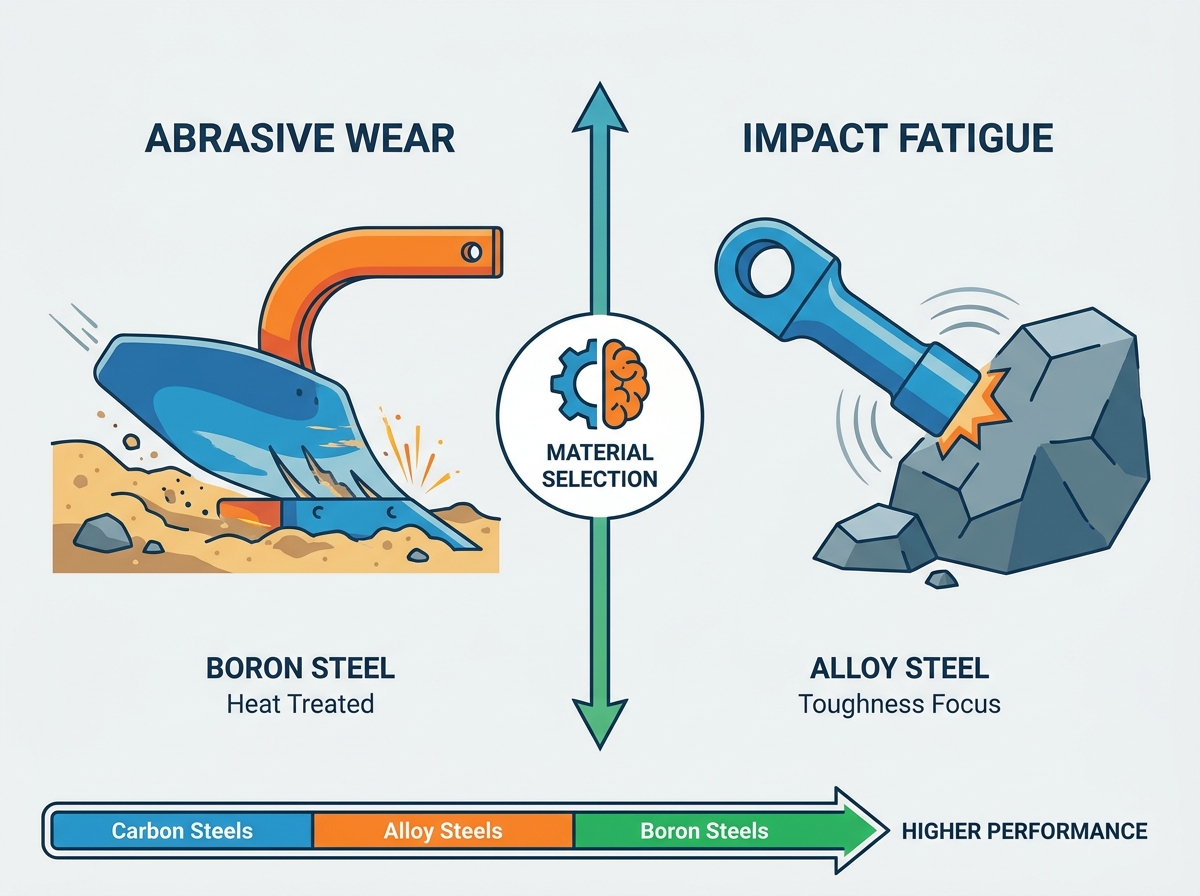
Selecting materials requires looking closely at individual part functions. A tractor axle handles vastly different forces than a plowshare. You must map the steel grade directly to operational demands.
Ground-engaging implements endure the harshest field conditions possible. When engineering forged power harrow parts, you face simultaneous high impact and severe abrasion. The operational demand dictates specific material recommendations. We highly recommend using Boron steel or high-carbon alloys for these items.
Evaluation criteria must remain strict. The finished part must achieve a hardness level of 45-52 HRC after heat treatment. Crucially, it must reach this hardness without becoming dangerously brittle. A brittle harrow tine will snap upon striking the first hidden stone.
Drivetrain elements transmit power from the engine to the implements. Their operational demands involve intense torsional stress, cyclic loading, and high shear forces. Standard carbon steel twists and deforms under such immense pressure. Material recommendations focus heavily on robust alloy steels.
We advise specifying 4140 or case-hardened 8620 alloys for drivetrains. Your evaluation criteria should prioritize core toughness and yield strength. Additionally, you must verify the grain flow alignment. The closed-die forging process aligns the steel's internal structure along the part's contours. This alignment multiplies the component's resistance to cyclic fatigue massively.
When producing durable forged agricultural machinery parts, precise heat treatment remains absolutely non-negotiable. Specifying a high-grade alloy becomes useless if the supplier lacks thermal processing expertise. Inconsistent heating destroys the mechanical properties of premium metals.
Quenching and tempering are essential steps for unlocking structural potential. Boron and Alloy steels require precise thermal cycles to perform correctly. The metal is heated to a critical temperature and cooled rapidly (quenching). It is then reheated gently to restore ductility (tempering). Ensure your suppliers utilize controlled cooling environments. Poor quenching introduces micro-cracking hidden beneath the surface.
Some components need intense localized wear resistance. Cutting edges or specific mounting points face disproportionate friction. Induction hardening targets these exact zones effectively. Electromagnetic fields heat specific areas before rapid quenching occurs. This process creates an incredibly hard exterior layer locally while keeping the surrounding core highly ductile.
The physical forging process fundamentally changes the metal's internal structure. Forging compresses the steel's grain structure forcefully. It forces the metallic grains to follow the exact contour of the part. This continuous grain flow multiplies the base material's strength substantially. It performs far better than identical shapes produced via casting or machining from raw bar stock. Casting leaves random grain structures and potential internal voids.
Best Practices for Processing:
Request specific heating and cooling curve charts from your forging partner.
Verify furnace calibration records to ensure temperature accuracy.
Mandate specific tempering durations to prevent brittle fractures.
Choosing a manufacturing partner dictates your final product quality. Procurement teams must look past simple unit costs. You must evaluate the supplier's commitment to metallurgical integrity and rigorous testing protocols.
A cheaper initial unit price rarely reflects the true cost. Purchasing a part that is 15% cheaper seems attractive initially. However, if that part requires mid-season replacement, it causes extensive financial damage. You face heavy labor costs, rushed logistics, and severely damaged brand reputation. Focus procurement decisions on maximizing equipment uptime and extending lifecycle reliability.
Reliable suppliers provide transparent material origins willingly. You must require Mill Test Certificates (MTCs) for every production batch. MTCs verify the exact chemical composition of the raw steel. Avoid suppliers relying on undocumented scrap metal or blended feedstocks. Unknown trace elements in scrap metal ruin predictable heat treatment responses completely.
Visible surface quality tells only half the story. Internal defects cause catastrophic failures under heavy field loads. Evaluate whether the supplier utilizes Non-Destructive Testing (NDT) routinely. They should use Magnetic Particle Inspection (MPI) to detect minute surface cracks. They must use Ultrasonic Testing (UT) to find internal voids or forging bursts. Parts must pass these checks before shipping.
Never move straight from CAD drawings to mass production. Request limited prototype runs first. Define specific destructive testing parameters for these prototypes. Conduct Charpy V-notch impact tests to validate material toughness practically. Confirm the chosen alloy behaves exactly as engineered before authorizing large-scale manufacturing volumes.
Successful agricultural machinery components demand meticulous engineering oversight. They sit at the exact intersection of correct material selection, optimized forging grain flow, and precise heat treatment. Overlooking any of these three pillars guarantees premature field failure. Prioritize alloys matching specific operational demands, whether combating abrasive soils or surviving heavy impacts. We advise procurement teams to audit their supplier’s metallurgical expertise immediately. Request specific material certifications and NDT protocols on your next RFQ to safeguard your equipment's field performance.
A: Trace amounts of boron significantly increase the steel's hardenability. This chemical reaction allows parts like plowshares and harrow tines to achieve extreme wear resistance during heat treatment. Boron steel provides this exceptional surface hardness at a much lower cost than highly alloyed alternatives, making it highly economical for agriculture.
A: Closed-die forging compresses metal under extreme pressure, creating a continuous grain flow structure. This structural alignment eliminates internal voids completely. It increases impact resistance and tensile strength dramatically. These continuous grain lines are critical for avoiding catastrophic, sudden failures during unpredictable field operations.
A: You should look for ISO 9001 certification to ensure baseline process consistency. Furthermore, demand EN 10204 3.1 certification for material traceability, commonly known as Mill Test Certificates. Finally, require documented Non-Destructive Testing (NDT) protocols, including ultrasonic and magnetic particle inspections, to verify structural integrity.


