
Views: 0 Author: Site Editor Publish Time: 2026-10-30 Origin: Site


Every high-performance industrial machine relies heavily on a rock-solid foundation. Structural integrity, precision alignment, and dynamic stability depend entirely on your chosen base material. Engineers face a constant commercial tension when designing heavy equipment. Over-engineering drives up manufacturing expenses and stretches lead times unnecessarily. Conversely, under-engineering directly compromises machining tolerances and severely shortens tool life. Making the wrong choice leads to catastrophic failures or wasted budgets.
You need deep clarity on how these metals actually perform under real-world stress. This guide provides an objective, engineering-focused comparison to simplify your procurement and design decisions. We will explore vibration dampening, tensile strength, and practical manufacturability. By the end, you will know exactly how to align your material choice with heavy industrial demands.
Vibration Control: Grey cast iron remains the industry standard for precision machinery due to its superior graphite-induced vibration dampening properties.
Impact Resistance: Cast steel is mandatory for high-impact, high-stress applications (like stamping presses) where tensile strength and ductility are required to prevent catastrophic failure.
Cost & Machinability: Cast iron offers lower raw material costs and superior machinability, resulting in a lower Total Cost of Ownership (TCO) for standard applications.
Strategic Selection: CNC machined casting material selection must balance dynamic rigidity, thermal stability, and the specific load profile of the end-use environment.
Engineers evaluate machine bases through distinct performance lenses. The most critical distinction lies between static rigidity and dynamic rigidity. Static rigidity simply means holding a heavy load without bending. A massive block of metal easily achieves this. However, modern manufacturing rarely involves purely static environments.
Dynamic rigidity measures how a frame maintains precision under active cutting forces. Extreme operational vibrations constantly challenge the structure. A machine base must resist deflection while simultaneously absorbing kinetic energy. This energy absorption is known as vibration attenuation.
Vibration attenuation dictates the final quality of your manufactured parts. Absorbing kinetic energy prevents tool chatter during aggressive milling. Tool chatter degrades surface finishes and accelerates premature bearing wear. If the frame cannot deaden these frequencies, the entire machine shakes itself apart over time.
Thermal stability adds another layer of complexity to base design. Industrial environments experience significant temperature fluctuations daily. Heat transfers from motors, friction, and ambient air into the machine frame. Materials expand as they absorb heat. This expansion directly impacts tight CNC tolerances. You must select a metal resisting rapid thermal distortion.
Finally, manufacturability drives the ultimate project feasibility. Your chosen material heavily impacts the foundry pouring process. Different metals require unique cooling rates and mold designs. Furthermore, these choices dictate the difficulty of subsequent machining operations. Some metals mill like butter, while others destroy expensive cutting inserts.
Grey cast iron dominates the precision machine tool industry. This dominance stems from its unique metallurgical structure. When evaluating cast iron machinery frames, you must understand the science of dampening. The metal features a dense matrix of microscopic graphite flakes.
These graphite flakes act as thousands of internal shock absorbers. They interrupt vibrational waves traveling through the metal frame. Because of this structure, grey cast iron deadens vibrations up to ten times faster than standard steel. It absorbs the kinetic energy generated by spindle rotation and aggressive cutting passes.
Thermal and dimensional stability further elevate cast iron for precision applications. The material boasts a relatively low coefficient of thermal expansion. It absorbs heat slowly and expands uniformly. Properly aged cast iron holds tight tolerances over decades of continuous use. You will rarely see historical machine bases warp spontaneously.
Machinability represents another massive advantage for foundry partners. The internal graphite actually acts as a built-in solid lubricant. During milling and drilling operations, chips break away cleanly. This natural lubrication significantly reduces tool wear. It also accelerates overall machining time, saving valuable production hours.
However, cast iron carries specific limitations and structural risks. The same graphite flakes interrupting vibrations also interrupt the steel matrix. This creates inherent brittleness. Cast iron possesses low tensile strength compared to other structural metals. It will crack or shatter under sudden, extreme shock loads. It cannot bend or yield when subjected to massive torsional forces.
When operations demand pure brute force, cast steel becomes the mandatory choice. This material excels where cast iron inevitably fails. Cast steel offers exceptionally high tensile strength and superior ductility. Ductility means the metal can yield and deform under stress.
Instead of fracturing during massive structural impacts, cast steel flexes slightly. This characteristic prevents catastrophic machine failure during heavy stamping or crushing operations. It absorbs extreme shock loading through temporary elastic deformation rather than shattering.
Weldability sets cast steel apart for complex fabrication projects. You can easily modify, repair, or extend a cast steel base. Engineers frequently weld additional structural supports or brackets directly onto the frame. This flexibility allows for hybrid structures. In contrast, welding cast iron requires highly specialized, risky processes to avoid cracking.
The excellent weight-to-strength ratio offers another compelling design advantage. Cast steel handles immense loads using much thinner wall cross-sections. This allows designers to shrink the overall footprint of the machine base. You reduce the total weight of the equipment without sacrificing any load-bearing capacity.
Despite these strengths, cast steel introduces severe limitations for precision equipment. Its primary flaw is remarkably poor vibration dampening. Kinetic energy rings through a steel frame like a bell. This ringing causes severe tool chatter in high-speed CNC applications. Furthermore, steel is highly susceptible to rapid thermal distortion. Machining cast steel is also notoriously difficult, demanding aggressive tooling and slower spindle speeds.
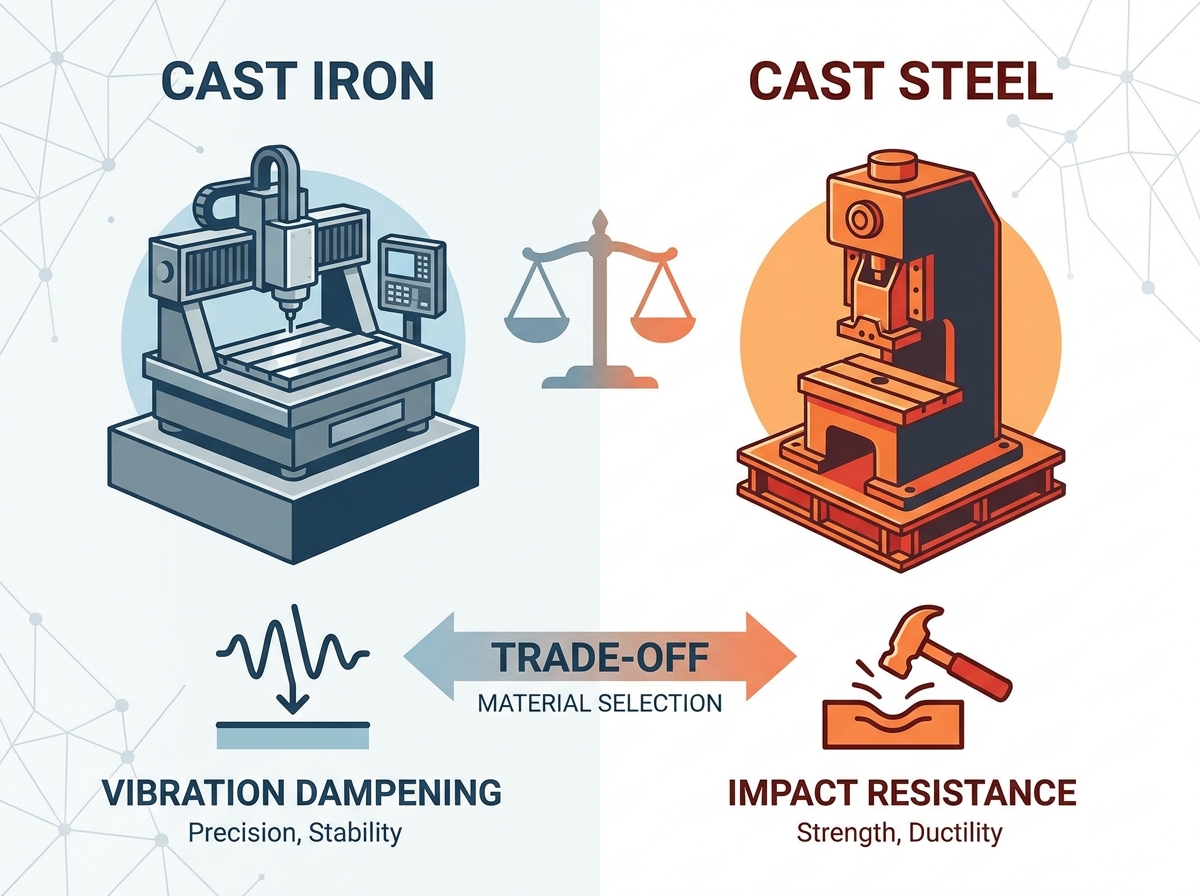
Choosing between these two materials requires accepting a fundamental engineering compromise. The core battle centers on vibration dampening versus tensile strength. You cannot maximize both properties simultaneously in a single standard pour. Grey cast iron absorbs kinetic energy flawlessly but lacks sheer load-bearing capacity. Steel supports incredible weight and impact but transmits every vibration directly to the cutting tool.
Proper CNC machined casting material selection dictates your entire manufacturing strategy. Material hardness heavily influences CNC programming. Steel requires rigid setups, specific cutting tool geometries, and careful chip management. Long, stringy steel chips can tangle around tooling. Conversely, cast iron produces powdery chips. These powdery chips require excellent dust extraction but allow for vastly improved cycle times.
When comparing cast iron vs cast steel machine bases, consider foundry capabilities and lead times. Standard grey iron pours are highly accessible. Many global foundries specialize in thick-walled iron castings. The metal flows easily into complex molds. Cast steel demands much stricter controls. Foundries must manage stringent cooling rates and precise heat-treatment cycles. Defect-free cast steel simply takes longer to source and manufacture.
Material Performance Comparison
| Performance Feature | Grey Cast Iron | Cast Steel |
|---|---|---|
| Vibration Dampening | Exceptional | Poor |
| Tensile Strength | Low (Brittle) | High (Ductile) |
| Thermal Stability | High | Moderate |
| Machinability | Excellent | Difficult |
| Weldability | Very Poor | Excellent |
Selecting the optimal base material prevents costly redesigns. You must analyze the primary operational stresses the frame will endure. Below is a practical framework for assigning materials to specific machinery types.
When to Specify Cast Iron:
Precision CNC mills, lathes, and grinding machines requiring zero tool chatter.
Coordinate Measuring Machines (CMMs) and highly sensitive optical inspection bases.
Applications prioritizing vibration control, ultra-smooth surface finish, and long-term thermal stability.
Frames requiring complex internal cooling channels or intricate webbed geometries.
When to Specify Cast Steel:
Heavy-duty stamping presses, forging hammers, and industrial rock crushers.
Equipment subjected to high tensile stress, repeated shock loading, or torsional twisting.
Bases that require post-casting structural welding or future heavy modifications.
Mobile industrial equipment where reducing overall mass is a strict requirement.
Modern engineering sometimes leverages hybrid approaches. Some manufacturers utilize cast steel sub-bases for floor mounting and load distribution. They then combine this with a cast iron upper frame to maintain cutting precision. Alternatively, specialized builders fill welded steel fabrications with epoxy granite. This polymer concrete mixture provides immense dampening while utilizing a steel exoskeleton.
Even the perfect material choice fails if foundry execution is poor. Foundry quality control dictates the structural integrity of your base. Both cast iron and cast steel face risks during the pouring phase. Shrinkage cavities can form as thick sections cool unevenly. Gas porosity often leaves hidden voids inside the metal walls.
To mitigate these risks, you must mandate Non-Destructive Testing (NDT). Visual inspections are insufficient for heavy machinery. Rely on ultrasonic testing to find internal voids. X-ray inspection provides clear imaging of critical load-bearing junctions. Finding a void during the CNC machining phase destroys project timelines.
Residual internal stresses present another hidden danger. As molten metal cools, it locks intense stress into the frame. If left untreated, the base will warp slowly over months. Stress relieving is absolutely mandatory. Cast iron frames undergo thermal stress relief in massive ovens. Some manufacturers still employ natural aging, leaving castings outside for months to stabilize before final precision machining.
Vendor vetting separates successful deployments from failures. You must evaluate foundry and machining partners rigorously. Consider these crucial vetting criteria:
Verify ISO certifications and documented quality control manuals.
Demand full material traceability, including chemical composition reports for every pour.
Confirm the foundry possesses the crane capacity and oven size to handle large-tonnage pours.
Assess their in-house NDT capabilities to ensure defects are caught before shipping.
Neither cast iron nor cast steel holds universal superiority in industrial design. Your selection is strictly dictated by the precise balance of vibration dampening versus impact resistance. Precision machining relies on the deadening characteristics of grey iron. Heavy forming operations demand the yielding strength of cast steel.
Remember that poor material selection leads to distinct, expensive failures. Vibrating steel compromises accuracy, ruining surface finishes. Shattered iron halts production and poses severe safety risks. Analyze your operational environment before finalizing any CAD drawings.
We encourage engineers to collaborate early in the design phase. Share your load specifications, expected environmental factors, and 3D models with a qualified foundry partner. A technical material consultation and manufacturability review will ensure your machine base performs flawlessly for decades.
A: Yes. Ductile iron features a nodular graphite structure rather than flakes. This modular shape prevents cracks from propagating easily. It offers significantly better tensile strength than grey iron while maintaining better dampening properties than steel. It acts as an excellent bridge for medium-impact applications.
A: The raw densities of both metals are nearly identical. However, cast steel bases often weigh less in application. Steel’s higher strength allows engineers to design thinner walls and lighter structures. If vibration control is not a priority, a steel design saves significant weight.
A: It is possible but highly risky. The localized heat from welding causes the brittle iron to crack rapidly as it cools. Successful repairs require intense pre-heating of the entire frame and specialized nickel welding rods. It is generally avoided unless absolutely necessary.
A: Epoxy-granite offers vastly superior vibration dampening compared to both cast iron and steel. However, it requires a completely different manufacturing process involving molds and room-temperature curing. It possesses lower tensile strength than steel and requires threaded metal inserts for mounting components.


