
Views: 0 Author: Site Editor Publish Time: 2026-11-04 Origin: Site


Machining a welded structure is inherently volatile. The extreme heat generated during welding introduces severe residual stresses deep within the metal frame. Later, removing surface material during the machining process suddenly releases those trapped stresses. This physical release causes the frame to warp, twist, or spring completely out of tolerance. Achieving exceptionally tight tolerances on large, complex fabrications demands predictable material behavior at every step. You must adopt a strictly controlled, multi-stage approach. This framework must prioritize proper thermal management, adaptive fixturing, and careful toolpath execution. Our goal is to provide engineering and procurement teams with an evidence-based framework. We will guide you through effective pre-machining treatments and smart tooling strategies. You will also learn the essential criteria for evaluating manufacturing partners to ensure long-term production success.
Distortion during machining is rarely a machine-tool error; it is the physical release of residual stresses trapped in the Heat-Affected Zone (HAZ) during welding.
Implementing proper stress relief for welded steel frames prior to machining is the highest-leverage step for ensuring dimensional stability.
Effective CNC machining after welding requires specialized fixturing that holds the part rigidly without over-constraining it or inducing mechanical stress.
Evaluating a manufacturing partner should focus on their ability to integrate both fabrication and machining processes under one roof to control the part’s complete thermal history.
To control distortion, we must first understand its root cause. Welding melts metal at extremely high temperatures. This creates localized expansion in the active weld zone. However, the surrounding cold metal strongly constrains this movement. As the weld pool cools and solidifies, it attempts to shrink. The unyielding cold metal prevents natural contraction. This tug-of-war locks massive tensile and compressive stresses into the final assembly. We call this residual stress.
These internal forces remain quietly balanced until manufacturing processes disrupt them. The machining phase acts as the primary trigger for distortion. CNC machines cut away the outer "skin" of the weldment. Unfortunately, this outer layer often holds the highest concentration of residual stress. When you remove this material, the internal forces suddenly rebalance. The part physically moves. It might spring back, twist, or bow during the machining cycle.
Failure to account for this physical reality guarantees poor outcomes. You will face a high volume of rejected parts. Unpredictable material movement also destroys expensive cutting tools. Furthermore, components forced into alignment during final assembly suffer from compromised structural integrity. These hidden stresses can lead to catastrophic field failures under dynamic loads. Controlling this physical movement is a foundational engineering requirement.
You cannot machine a moving target. Stabilizing the material before it reaches the CNC mill is mandatory. Engineers rely on several methods to neutralize internal stresses before cutting begins.
Thermal stress relief is widely considered the industry gold standard. Facilities place the entire weldment into a calibrated industrial oven. They heat the part to a specific temperature, usually just below the critical transformation point. They hold this temperature to relax the internal atomic structure. Finally, they cool the oven very slowly. This controlled process is the most reliable method of stress relief for welded steel frames. However, thermal treatment has drawbacks. It adds significant cost and extends lead times. It also creates a heavy oxide scale on the metal, requiring secondary sandblasting before machining.
Vibratory Stress Relief (VSR) offers an alternative stabilization method. This process applies sub-harmonic vibrations directly to the physical structure. The vibrations gently redistribute internal stresses without applying any heat. VSR is highly effective for massive, heavy-wall structures. It works well when thermal treatment is physically impossible or cost-prohibitive. Yet, VSR has strict limitations. It proves much less effective for complex, thin-walled geometries. It is also generally unsuitable for high-tolerance aerospace aluminum components.
Finally, we must address the concept of natural aging. Some machinists believe leaving a weldment outside to "season" for several months relieves stress. This is a persistent manufacturing myth. Weathering a part does not significantly alter its internal stress matrix. Natural aging is an outdated, unscalable approach. Modern production timelines cannot accommodate it. You must rely on active thermal or vibratory processes instead.
| Method | How It Works | Best Application | Primary Drawbacks |
|---|---|---|---|
| Thermal (Annealing) | Heats the part in an oven, holds temperature, and cools slowly. | High-precision steel frames requiring maximum stability. | High cost, long lead times, causes surface scale. |
| Vibratory (VSR) | Applies sub-harmonic vibrations to redistribute stress matrices. | Massive, thick-walled weldments too large for ovens. | Ineffective on thin walls or aerospace aluminum. |
| Natural Aging | Leaves the part outdoors over months to "settle". | None (Outdated practice). | Unscalable, unreliable, does not effectively relieve deep stress. |
Even with perfect stress relief, raw weldments are rarely flat. They contain natural bows and twists from the fabrication process. This introduces a major risk during machine setup. Operators often try to force a warped weldment flat against the machine table using heavy clamps. This approach is highly destructive. Clamping a bowed part flat induces tremendous mechanical stress into the material. The CNC machine cuts a perfectly flat surface into this stressed state. Once the operator releases the clamps, the part immediately springs back to its warped shape. This completely destroys your carefully machined tolerances.
To avoid over-constraining the part, shops must use adaptive workholding techniques. The goal is to support the part in its natural, relaxed state before cutting begins. Machinists achieve this using kinematic mounts, adjustable jacks, and custom shimming. They carefully measure the gaps under the part and fill them. This provides rigid support without forcing the metal to bend.
Specialized potting compounds offer another excellent adaptive solution. Shops apply quick-setting epoxies or low-melt bismuth alloys around complex features. These compounds flow into gaps and solidify. They stabilize thin-walled sections and reduce tool chatter entirely without physical clamping pressure. Once machining finishes, operators melt or chip the compound away.
Modern equipment also utilizes in-process metrology to manage warped materials. Machine-integrated touch probes, like those from Renishaw, act as a game-changer. The CNC machine uses the probe to map the actual topography of the weldment before executing any toolpaths. The controller analyzes this data and makes dynamic offset adjustments. This ensures the toolpath perfectly aligns with the part's natural state.
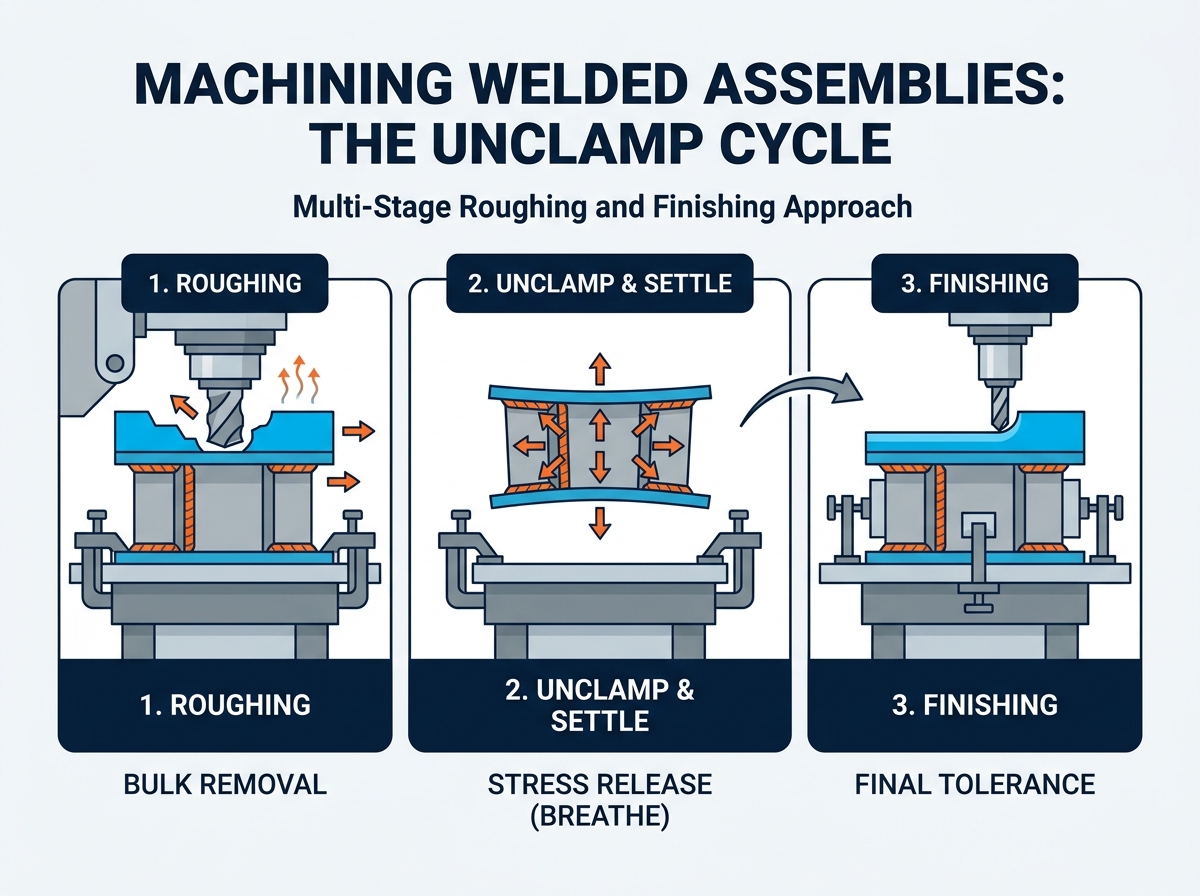
Toolpath strategy plays a massive role in managing material movement. You cannot machine a weldment in a single aggressive pass. Shops must utilize a deliberate, multi-stage roughing and finishing approach.
The process begins with aggressive roughing passes. The machine removes the vast bulk of the excess material. As discussed earlier, cutting away this material inevitably causes some stress release and physical movement. The part will warp slightly, even after thermal stabilization.
Because the part moves during roughing, you must execute an unclamp and re-clamp cycle. This is the most crucial step in the entire process. The operator completely unclamps the part from the table. They let the metal "breathe" and settle into its new, natural shape. Skipping this step guarantees a failed part. The operator cleans the fixture and prepares for the final stage.
Next, the operator sets up the finishing passes. They re-clamp the part using minimal force. They often use finger-tight pressure on adjustable supports to prevent distortion. The machine then executes final, low-depth-of-cut finishing passes. Because the bulk stresses are gone, these light cuts achieve the final geometry flawlessly.
Tooling and heat management also demand strict attention. The process of CNC machining after welding introduces its own intense thermal loads. If the cutting tool pushes too hard, it generates localized heat, expanding the part mid-cut. Machinists combat this by using sharp, high-positive-rake cutting tools. These specialized inserts slice cleanly through the metal, minimizing cutting pressure and heat generation.
Coolant strategies further protect the part's dimensional stability. Strategic use of high-pressure coolant evacuates hot chips instantly. In some cases, operators use heavy air blasts instead of liquid coolant. This prevents localized thermal shock while keeping the cutting zone clear.
Procuring machined weldments requires careful vendor evaluation. Separating welding and machining across different vendors creates a massive liability loophole. If the final part warps, the machinist will blame the welder for poor heat control. Simultaneously, the welder will blame the machinist for bad fixturing. This finger-pointing leaves you with scrapped parts and blown deadlines.
Vertical integration acts as a powerful risk mitigation strategy. You should partner with facilities that perform both fabrication and machining under one roof. Single-source vendors control the part’s complete thermal history. They take full accountability for managing welded assembly machining distortion from the first arc strike to the final inspection.
When evaluating potential partners, ask targeted questions across three specific dimensions:
Process Control: Do they use documented standard operating procedures (SOPs) for weld sequencing? Ask about their heat input control strategies. Techniques like skip welding and balanced welding minimize initial distortion.
Equipment: Do they possess a suitably large Coordinate Measuring Machine (CMM)? They must verify final tolerances post-machining while the part remains in their shop. Relying solely on hand tools for large weldments is a red flag.
Expertise: Ask their manufacturing engineers to explain their setup process. Can they clearly articulate their roughing-to-finishing unclamp procedures for your specific alloy? If they do not mention unclamping the part, walk away.
Once you shortlist competent vendors, transition carefully into prototyping. Never order a full production run immediately. Start with a rigorous First Article Inspection (FAI) process. Mandate that the vendor explicitly measures dimensional stability 48 hours post-machining. This waiting period exposes any delayed spring-back before you approve mass production.
Controlling distortion during the machining of welded assemblies is never a matter of luck. It demands physics-driven process controls. Success requires a seamless integration of intelligent fabrication, mandatory stress relief, adaptive fixturing, and staged machining cycles. Ignoring any of these steps results in warped frames, damaged tooling, and costly production delays.
You must actively manage residual stresses rather than hoping they do not exist. Work closely with your engineering team to review all 3D CAD models before cutting metal. Evaluate your tolerance requirements realistically. Consult your manufacturing partners to determine the most cost-effective stress relief and machining strategies tailored for your specific application.
A: For non-critical tolerances (e.g., +/- 0.050"), you may safely skip stress relief to save time. However, for high-precision applications requiring tight tolerances (e.g., +/- 0.001"), stress relief is completely non-negotiable. Skipping it will inevitably result in warped, scrapped parts.
A: Aluminum possesses a significantly higher coefficient of thermal expansion and higher thermal conductivity than steel. This makes it far more susceptible to severe distortion. Specialized tempering, such as a T6 heat treatment post-weld, is often required before machining aluminum assemblies.
A: Probing and macro-variables can effectively adjust datum points to account for initial stock variation. However, they cannot stop a part from physically moving after material is removed. The underlying material must be thermally and mechanically stable first.


