
Views: 0 Author: Site Editor Publish Time: 2026-10-08 Origin: Site


Premature fluid end failure is not just a mechanical nuisance. It acts as a critical driver of non-productive time for modern frac fleets. This unpredictable downtime directly escalates daily operating expenses. Modern completions rely on incredibly harsh operating environments. Operators constantly push equipment limits through higher pressures, continuous pumping, and highly aggressive proppants. Wear will always happen in these extreme conditions. However, premature wear signals a deeper operational problem. It shows a severe misalignment between component specifications, operating conditions, or maintenance protocols.
Moving past basic symptom treatment requires serious analysis. You must evaluate the root causes behind these frequent equipment breakdowns. In this comprehensive guide, we will explore evidence-based criteria for repairing, rebuilding, or replacing critical parts. You will learn how to identify specific wear patterns early. We will also help you establish strict procurement standards. By applying these strategies, you can stabilize your pumping operations and extend the operational lifespan of your fleet.
Premature fluid end component wear is typically driven by a combination of cavitation, corrosive fluid chemistry, and abrasive proppant degradation.
Identifying specific high pressure pump component failure causes (e.g., localized washout vs. fatigue cracking) dictates whether a part should be repaired, rebuilt, or scrapped.
Transitioning from traditional carbon steel to advanced stainless alloys or modular designs requires a strict TCO (Total Cost of Ownership) evaluation, balancing upfront costs against operational lifespan.
Evaluating fluid end vendors requires scrutinizing their metallurgical sourcing, heat-treating processes, and non-destructive testing (NDT) documentation.
Establishing a baseline for acceptable operational lifespans is your first crucial step. Standard carbon steel fluid ends might last roughly 400 to 600 pumping hours under normal conditions. Advanced stainless blocks can often exceed 1,000 hours. We define "premature" wear as any failure occurring well before these expected benchmarks. If your fluid ends fail at 200 hours, you are experiencing unacceptable early failure. This discrepancy indicates underlying mechanical or operational flaws.
The compounded costs of this early failure run deep. You face the obvious direct replacement costs for blocks, valves, and packings. But the financial penalty extends much further. You must account for expensive onsite labor and hazardous field repair conditions. Most importantly, active-site downtime drains profitability. Halting a frac fleet costs thousands of dollars per hour. The business impact of unpredictable fluid end component wear severely damages your bottom line.
Many fleet managers try to compensate for poor component longevity through over-maintenance. They schedule excessively frequent maintenance intervals. Crews might swap packings and valves prematurely just to avoid catastrophic block failures. This reactive strategy artificially inflates fleet operating costs. It also introduces new risks. Every time a technician opens a pump in dirty field conditions, they risk introducing debris. Over-maintenance wastes perfectly good consumables and drives up your capital expenditures.
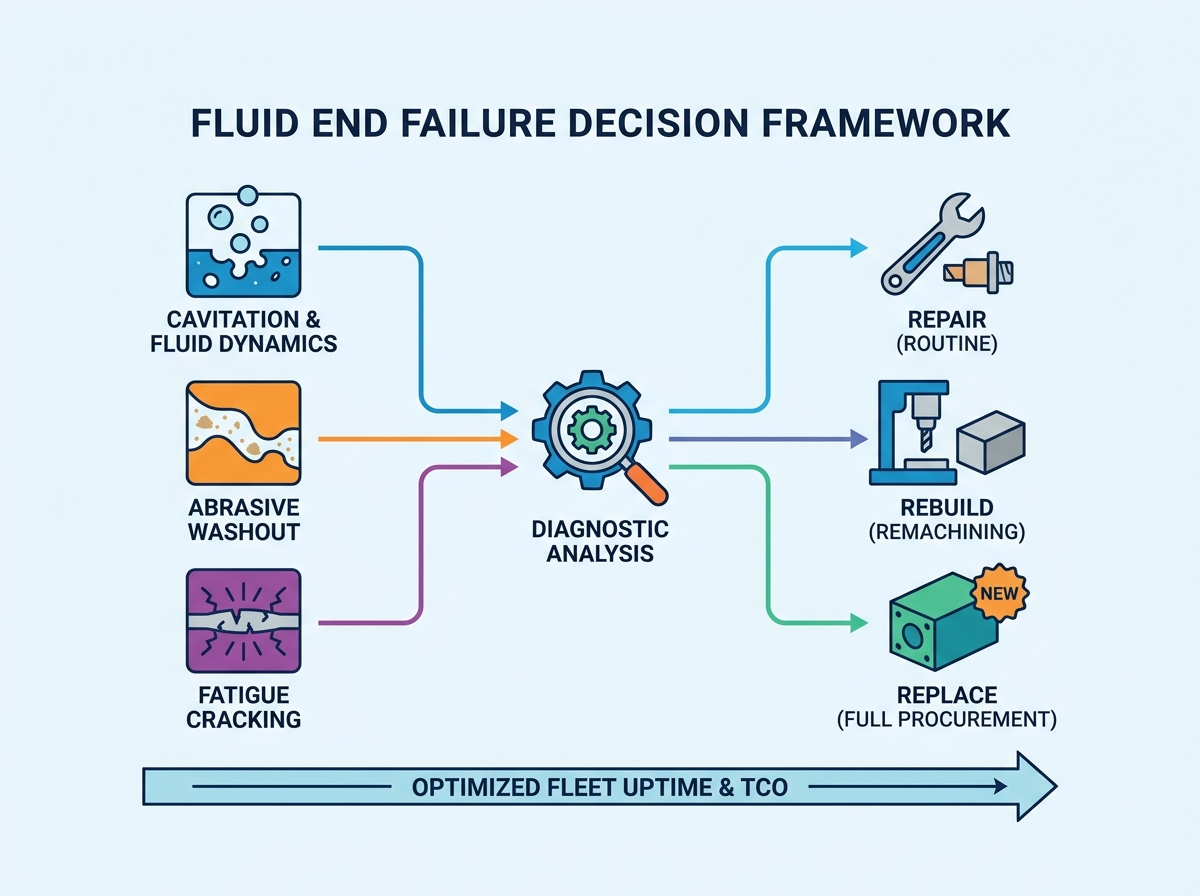
Treating symptoms will never cure your equipment problems. Properly analyzing high pressure pump component failure causes remains essential for long-term fleet stability. You must inspect damaged parts to identify the specific failure mechanism. Below, we break down the four most common root causes and their telltale signs.
Modern fracturing operations rely heavily on large volumes of sand. This high-velocity abrasive slurry acts like liquid sandpaper inside your pumps.
Mechanism: High-velocity sand and aggressive proppants constantly score internal geometries. The fluid finds microscopic imperfections and begins carving paths into the metal.
Evidence to look for: You will notice deep channeling and localized erosion. This damage almost always appears around intersecting cross-bores and discharge ports. The metal will look smoothly carved or scalloped.
Valves control the heart of the pumping cycle. When they fail to seat properly, the entire system loses efficiency and structural integrity.
Mechanism: Incomplete valve seating happens when debris gets trapped between the valve and the seat. This tiny gap allows fluid to shoot through at extreme velocities during the pressure stroke. We call this phenomenon wire-drawing or fluid cutting.
Evidence to look for: Premature fluid end valve seat wear shows distinct pitting and grooving on the valve seat taper. Operators will also notice a sudden loss of volumetric efficiency on the pump data logs.
Fluid dynamics play a massive role in pump longevity. Starving a pump of fluid creates violent reactions inside the block.
Mechanism: Insufficient charge pump pressure causes starvation. This allows air entrainment inside the fluid stream. As the plunger pressurizes the chamber, these trapped air bubbles violently collapse. These micro-implosions blast tiny shockwaves against the internal metal walls.
Evidence to look for: Inspect the suction valves and internal lower bores. You will find sponge-like pitting. The metal looks like it has been eaten away by acid or sandblasted aggressively.
Pump blocks flex slightly during every single pressure cycle. Over millions of cycles, the metal eventually tires out.
Mechanism: Cyclic loading eventually exceeds the structural fatigue limit of the material. Highly corrosive fluid chemistry often exacerbates this issue. This creates a deadly combination known as corrosion-fatigue. The chemical attack weakens the grain boundaries of the steel.
Evidence to look for: Technicians will find micro-cracks initiating at specific stress concentrations. Intersecting bores and internal threads are the most common starting points. If left unchecked, these tiny cracks propagate outward, leading to catastrophic block failure.
Once you understand why your fluid ends fail, you must choose the right technological solution. Operators generally choose between upgrading metallurgy or shifting their entire fluid end architecture.
Selecting the right block material requires balancing initial capital output against expected operational life. Traditional carbon steel (like 4340) offers a lower entry price. However, it suffers greatly in corrosive basins. Stainless steel alloys, particularly 15-5 and 17-4 PH, have become the new industry standard for severe environments. They offer superior corrosion resistance and a significantly extended fatigue life.
You must also address implementation risks when upgrading materials. Stainless steel blocks often weigh more than traditional carbon blocks. You must verify weight compatibility with your existing trailers. Furthermore, you need to ensure the new blocks align perfectly with your existing power ends to prevent structural misalignment.
Comparison of Fluid End Block Materials
| Material Type | Corrosion Resistance | Fatigue Life | Upfront Cost Premium | Ideal Application |
|---|---|---|---|---|
| Carbon Steel (4340) | Low | Standard (400-600 hrs) | Baseline ($) | Sweet wells, low-pressure basins, strict budget limits |
| Stainless Steel (15-5 PH) | High | Extended (1000+ hrs) | High ($$$) | Harsh corrosive environments, continuous pumping |
| Stainless Steel (17-4 PH) | Very High | Maximum (1200+ hrs) | Highest ($$$$) | Extreme high-pressure, highly acidic fluid chemistry |
The industry continues to debate the merits of traditional monoblocks versus modular fluid ends. A monoblock machines all pumping cylinders from a single massive steel forging. If one cylinder cracks, you must discard the entire block. Modular designs split the fluid end into individual cylinder segments.
You must carefully assess this operational shift. Modular architectures allow field crews to swap individual cylinders. This significantly reduces replacement material costs over time. However, you must evaluate specific success criteria. Does the reduction in material waste offset the increase in maintenance complexity? Modular units have more seals, more tie-rods, and demand highly precise torqueing procedures. They also require a larger initial capital expenditure.
Manufacturers use advanced internal treatments to fight fatigue cracking. Autofrettage is a critical process for modern fluid ends. The factory applies extreme internal hydrostatic pressure to the block. This pressure yields the inner bore, creating a permanent layer of residual compressive stress. This compressive layer actively squeezes the metal together, making it much harder for micro-cracks to open.
Shot peening serves a similar purpose. Tiny steel spheres blast the internal geometries at high speeds. This also induces residual compressive stress on the surface layer. Both treatments deliver verifiable benefits in mitigating crack initiation. You should always demand these treatments for high-pressure applications.
Every maintenance manager faces a critical choice when a fluid end goes down. Making the wrong decision compromises site safety and wastes capital. You need a strict, evidence-based decision framework to guide your maintenance teams.
Routine field repairs keep the fleet running during a pad sequence. You should limit these repairs to easily accessible consumable parts.
Criteria: You identify minor packing leaks or notice a drop in pressure indicating minor valve or seat wear.
Action: Conduct immediate onsite visual inspections between stages. Replace these consumables before they cause permanent washout damage to the block. Do not ignore a leaking packing. The abrasive fluid will quickly carve into the stuffing box, forcing a major shop rebuild.
When field repairs are no longer sufficient, you must send the block to a qualified machine shop. Remachining breathes second life into worn blocks, provided the damage is not too deep.
Criteria: The block shows minor internal washouts, a scored stuffing box, or damaged threads. Crucially, this damage must remain within safe, published machining tolerances.
Action: Require strict adherence to OEM dimensional tolerances. You must demand transparency from the machine shop. Ask exactly how much material they remove. Removing internal material enlarges the bore. This directly impacts the future pressure rating and structural integrity of the block.
Certain types of damage represent a hard stop. You cannot safely salvage a structurally compromised fluid end.
Criteria: The shop detects internal cracks via Magnetic Particle Inspection (MPI) or Ultrasonic Testing (UT) at critical stress junctions. Alternatively, the internal wear exceeds the maximum allowable machining limits.
Action: Do not attempt to weld-repair critical high-pressure blocks. Welding alters the metallurgical grain structure and introduces massive failure risks at 15,000 PSI. Scrap the block entirely. Initiate procurement of new fluid ends based on your updated operational demands.
Choosing the right manufacturer is just as important as choosing the right material. The market is flooded with inferior knock-offs that promise the world but fail in the dirt. You must apply rigorous standards when evaluating vendors.
Manufacturing Transparency: Avoid vendors making unsubstantiated "lifetime" claims. In the frac industry, nothing lasts a lifetime. Demand verifiable data on MTBF (Mean Time Between Failures) under specific basin conditions. Ask for references from operators running similar pressures.
Metallurgical Integrity and QA/QC: Quality starts at the forge. Require comprehensive documentation of their material sourcing. Avoid vendors who use inferior billet origins or poorly controlled forgings. Check for strict adherence to API standards and relevant ISO manufacturing certifications.
Inspection and Testing Protocols: A good vendor proves their quality before shipping. Ensure the manufacturer utilizes comprehensive Non-Destructive Testing (NDT). They must conduct ultrasonic and magnetic particle inspections both post-machining and post-heat treatment. Ask for these certificates with every delivery.
Supply Chain Scalability: Your vendor must act as a reliable partner. Evaluate their ability to consistently deliver replacement parts. A great fluid end is useless if you cannot source valves, seats, and packing on short notice. Ensure they hold adequate local inventory to prevent localized supply bottlenecks.
Premature equipment failure drains profitability and disrupts critical completion schedules. However, you can control these variables. If fleets move away from reactive maintenance, they can drastically reduce unexpected downtime. You must adopt a root-cause analysis approach to every fluid end failure.
To stabilize your fleet and improve operational margins, focus on these immediate next steps:
Advise your procurement and engineering teams to audit current failure logs to identify recurring wear patterns.
Apply the repair, rebuild, or replace matrix to remove emotion and guesswork from maintenance decisions.
Upgrade your consumable replacement schedule to prevent minor leaks from causing permanent block washout.
Initiate tough conversations with your current manufacturers. Demand transparent metallurgical records and verifiable NDT testing data.
A: The most common cause is fluid cutting, also known as wire-drawing. This occurs when abrasive sand or debris prevents the valve from sealing completely against the seat. During the high-pressure stroke, fluid shoots through this tiny gap at extreme velocities. This rapidly erodes the metal, causing deep grooving and immediate loss of pump efficiency.
A: Autofrettage involves applying extreme internal hydrostatic pressure to the fluid end block during manufacturing. This pressure intentionally yields the inner bore. When the pressure is released, it creates a permanent layer of residual compressive stress. This compressive layer tightly squeezes the metal, which actively resists fatigue crack initiation during field operations.
A: A fluid end is beyond repair when internal washouts exceed the manufacturer's safe remachining tolerances. It is also completely unserviceable if Non-Destructive Testing (NDT) reveals structural micro-cracking in the cross-bore intersections or threads. You should never attempt to weld-repair these high-stress areas, as it creates a severe safety hazard.


